BLOGS
How Ankar Cites Every Output: Verifiable AI-Assisted Patent Work
Wiem Gharbi
Co-founder
AI is becoming central to patent drafting and prosecution. But for most patent practitioners, adoption still hinges on one question: Can I trust what is being generated?
In our conversations with senior patent professionals, we repeatedly hear the same message: speed alone is meaningless if you can’t stand behind the output.
That insight is foundational to how we build Ankar.
Why Traceability to the Source is Key in Patent Practice
Patent strength depends on rigorous patent work to ensure both defensibility and enforceability. To ensure compliance with legal requirements and mitigate practitioner liability, every claim, specification, statement and amendment – i.e., any action during drafting or prosecution, must be supported by the original disclosure, including all technical input and data provided by the inventors and applicant.
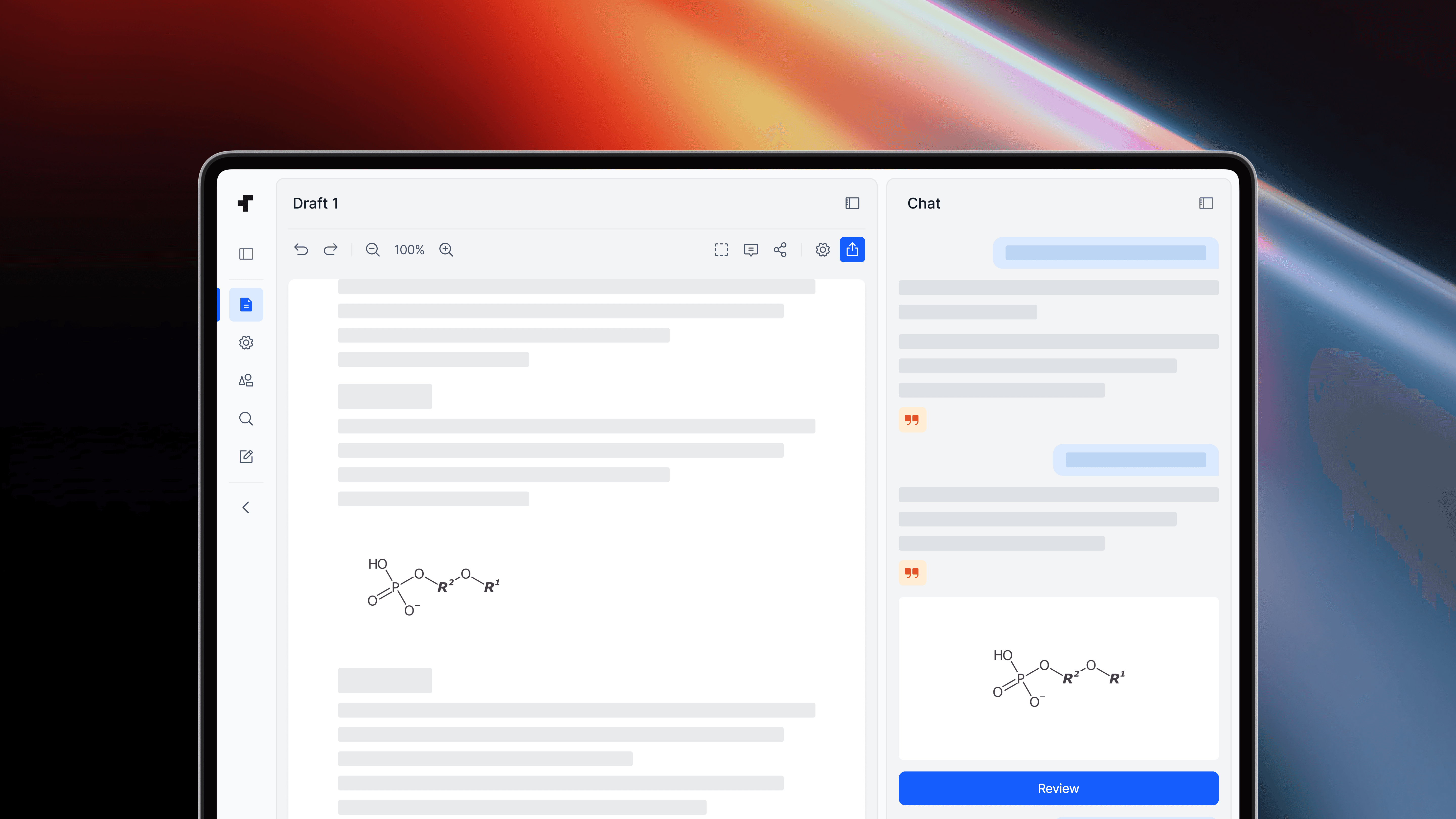
This is why Ankar is built with full source traceability: every AI generated output can be traced back to the input documents that you have uploaded into the platform, enabling independent verification by the practitioner.
Our platform enables:
Paragraph-level traceability: Trace how claims are supported by the invention disclosure, and how amendments and arguments are derived from underlying application or prior art documents
Faster document review and validation: Patent practitioners do not need to manually trace where content comes from, and can also understand documents faster
Professional accountability: The tool’s output is verifiable through citations. This allows responsibility to stay with the patent practitioner, where it belongs
Power of persuasion: An argument supported by relevant source documents is much more likely to sway an Examiner’s opinion than a bare argument
As AI takes on more substantive work, the ability to trace every generated statement back to its input documents is what turns Ankar from a black box into a professional tool.
Review and Analyse Documents Faster
Patent practitioners often draft from large volumes of fragmented documents, including invention disclosures, inventor transcripts, prior art references and technical documents. A good claim set or embodiment in the description must be closely aligned with and supported by the source documents.
Ankar analyses these large document sets and cites disclosures, transcripts, and supporting documents directly in the output (i.e. specification), making it easier to confirm clear documentary support for each claim position while maintaining full traceability.
Trace claim scope to disclosed chemicals
In chemical and pharmaceutical patents, Markush expansions are based on originally disclosed compounds, including exemplified ones. Claims lacking explicit support in the initial disclosure not only risk rejection during examination but also, if granted, face significant vulnerability to post-grant proceedings, rendering the patent unenforceable.
In Ankar, generated claims and Markush structures explicitly cite uploaded chemicals, allowing users to quickly validate ideas and identify new broadening strategies without sacrificing validity or enforceability.
Verifiable argument suggestions in Office Actions
Office Action arguments are significantly stronger if they are supported in the original disclosure. Tying every new limitation back to explicit source language, and related technical effects, is critical to provide options during examination, preserve validity, avoid added-matter risk, and maintain defensible claim scope.
Ankar’s tool improves the strength and compliance of your patent arguments by automatically citing your claims and specification in every generated response, ensuring alignment with U.S. patent laws, EPO requirements, or any other jurisdiction that you might be prosecuting in.
Enabling Confident and Responsible AI Adoption
By tracing sources throughout drafting and prosecution, Ankar makes the AI output easily verifiable, which enables teams to:
Maintain accountability
Adopt AI incrementally
Build internal confidence
The result is faster workflows, without compromising trust.
Subscribe to our Newsletter
share
read next

Enhanced Drafting in Ankar with Native Word compatibility
Today, we're introducing a completely redesigned editing experience in Ankar for seemless compatibility with Microsoft Word, further enhancing our existing suite of advanced document editing capabilities.
Read now

CAFC Reverses PTAB Invalidity Findings in Google Hotword Detection Patent Dispute with Sonos
The U.S. Court of Appeals for the Federal Circuit (CAFC) issued a decision on June 9 in Google LLC v. Sonos, Inc., reversing Patent Trial and Appeal Board (PTAB) final written decisions (FWDs) that held claims of two Google patents unpatentable. The court found the Board’s anticipation findings were not supported by substantial evidence and remanded the case for further proceedings.
Read now

Senior Patent Partner Joins Ankar as Head of Patent Innovation
Harm van der Heijden is to join Ankar AI as head of patent innovation after 17 years in private practice
Read now