
Community blogs
Your Patents Are an Asset Class. Most Companies Treat Them Like a Filing Cabinet.

Seth Cronin
Director, ipCapital Group

Here's a number worth sitting with: 90% of the S&P 500's market value is intangible assets. That's north of $21 trillion: patents, brands, trade secrets, data, customer relationships. The companies in that index collectively hold more value in things you can't touch than the entire GDP of the United States.
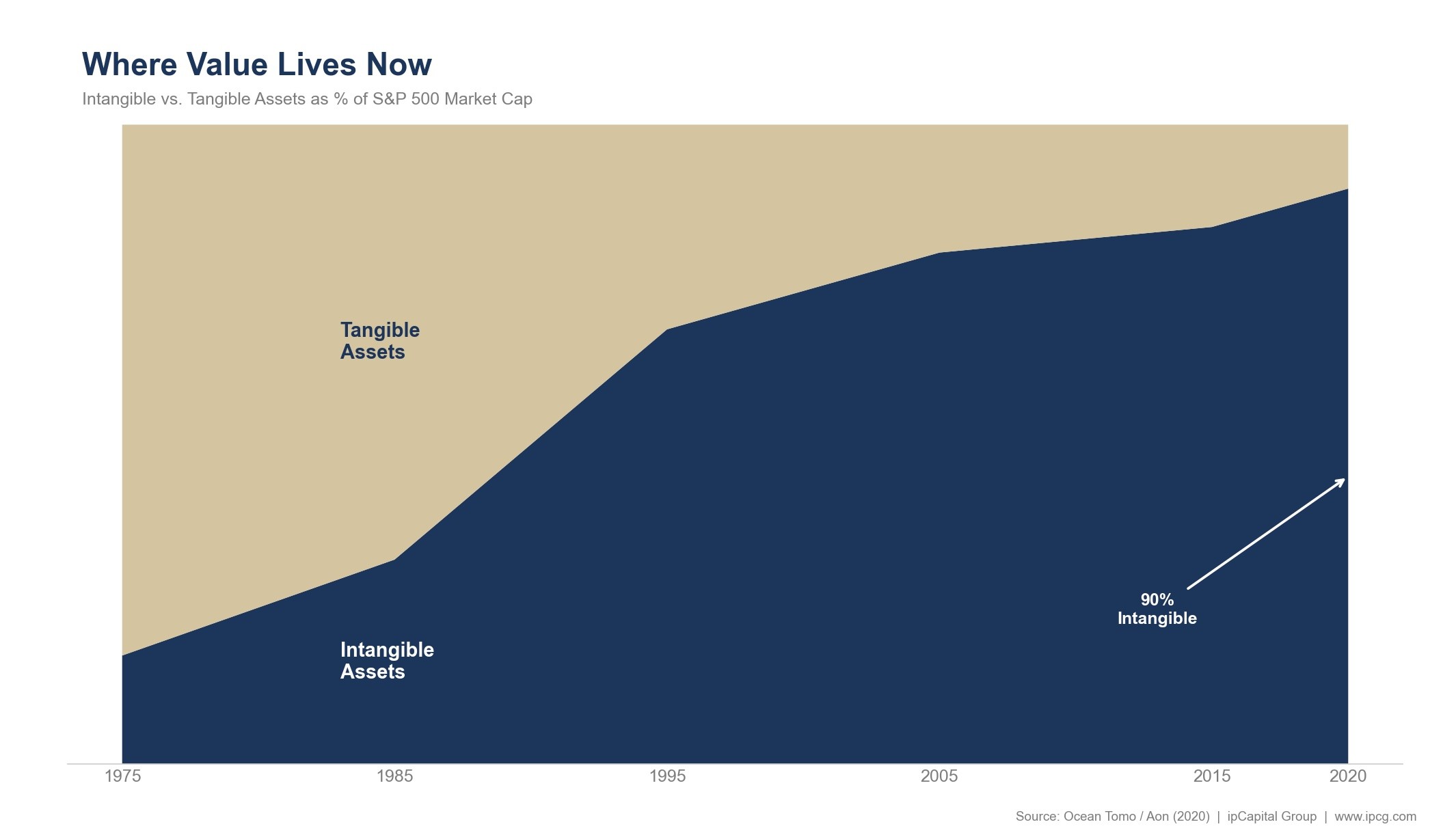
Intangible assets account for 90% of S&P 500 market value. Source: Ocean Tomo / Aon (2020).
Now ask yourself: what percentage of those companies can tell you, with documentation, what their patent portfolio specifically contributes to that number?
My guess? Single digits.
This is the quiet crisis in intellectual property strategy. Companies invest real money in R&D, file real patents, pay real maintenance fees, and then treat those patents like insurance policies collecting dust in a drawer. They know the IP is valuable. They just can't say how valuable, to whom, or why. And they find out how much that uncertainty costs them at exactly the wrong moment: when an acquirer's counsel starts asking questions, when an investor wants to see the IP story, or when a licensing opportunity shows up and nobody can defend a number.
The Map Is Not the Portfolio
I learned this lesson working with a founder who had a potential $100 million acquisition on the table. Fortune 500 company, serious interest, and a patent portfolio that looked solid: granted patents, clean prosecution, strong claims.
Then we looked at what the acquirer actually cared about.
The technology would save them 80-90% of their energy costs over ten years. That's the value proposition. That's what drove the deal. His patents? They protected the prior version of the tech. Not the energy savings breakthrough. Not the economic case the acquirer was building their model around. The IP and the business value were pointing at different things.
Without the right patents, he was looking at a drastically different deal, or no deal at all.
We identified the gap, drafted three new inventions targeting the actual value proposition, and filed them with counsel seven days later. But the real story isn't the seven-day sprint. It's that nobody had ever mapped his patents to what he was actually selling. That gap existed for years. It was invisible until the biggest transaction of his career almost collapsed on it.
Valuation Is Not an Accounting Exercise
When most patent professionals hear patent valuation, they think litigation support. Damage calculations. Expert reports. Adversarial proceedings where someone needs a defensible number.
That's one use. It's not the most important one.
Rigorous patent valuation done proactively tells you things you can't learn any other way:
· Which patents genuinely drive business value versus which ones are expensive coverage you could abandon
· Where your claim scope has gaps relative to what you're actually commercializing
· How your portfolio stacks up against competitors in the same technology space
· What the portfolio would command in a licensing deal, an acquisition, or as collateral for financing
The demand for this kind of analysis is growing fast. The patent valuation services market is projected to reach nearly $4 billion by 2030, growing at over 10% annually. If you think litigation is driving it, you’d be wrong. Companies are waking up to the fact that IP is a strategic asset that deserves to be managed like one.
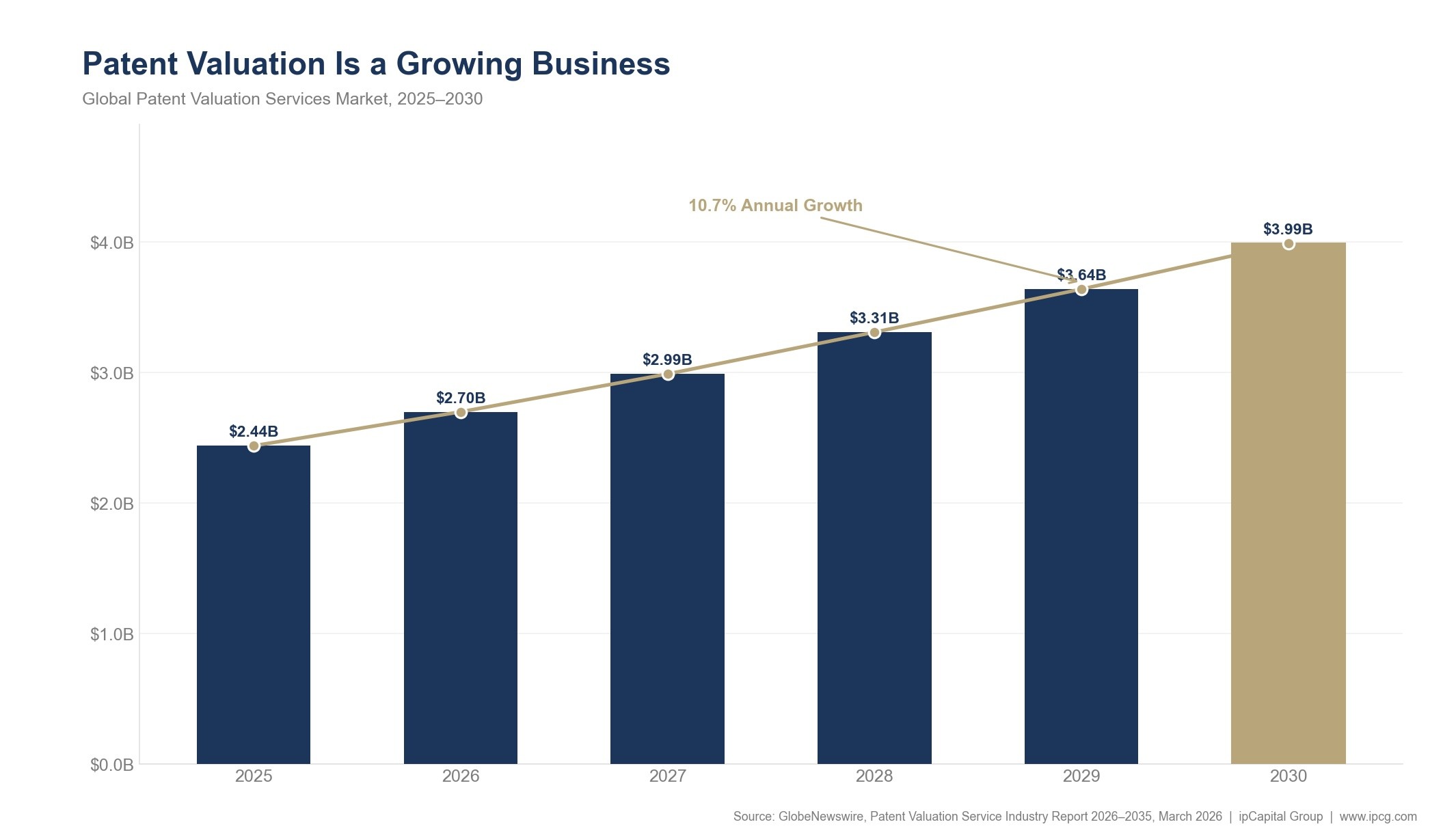
The patent valuation services market is on pace to reach $3.99B by 2030. Source: GlobeNewswire, March 2026.
Three Places This Changes the Outcome
M&A. Portfolio strength and freedom-to-operate analysis can shift acquisition premiums by 10-30%. That's not a rounding error. On a $200 million deal, that's $20-60 million. Acquirers discount uncertainty. A well-documented valuation removes the uncertainty, and the value flows to the seller.
Investor Relations. Raw patent counts are nearly meaningless to sophisticated investors. What signals real innovation health is a portfolio where claims align with the product roadmap, coverage extends across key jurisdictions, and someone has done the work to connect IP to addressable market opportunity. A documented valuation gives you that story in a language capital markets understand.
Asset-Based Financing. Banks and lenders are getting more sophisticated about IP collateral. A rigorously valued, well-documented patent portfolio can support credit facilities and bridge financing in ways that a spreadsheet of patent numbers never could. This is especially relevant for R&D-heavy companies that are IP-rich but cash-constrained.
The Uncomfortable Question You Should Be Asking
If your clients, or your company, cannot answer what is this patent portfolio worth, and why, with documentation to back it up, that's a gap in your IP strategy. More, it's a gap in your business strategy.
The companies winning at IP are not necessarily filing more patents. They're doing the harder work of understanding what they have, documenting its value, and deploying that documentation at the right moment. They know their strongest claims. They know which patents map to actual revenue. They know what a buyer or investor will find when they look under the hood.
That work doesn't happen automatically. It doesn't happen when you file. And it doesn't happen when someone forces your hand during due diligence.
It happens when you decide to treat your patents like the assets they actually are.
Seth Cronin a strategic IP advisory firm specializing in invention, patent strategy, portfolio management, and IP valuation. Learn more at www.ipcg.com |
READ NEXT

Is the PHOSITA real?
By Michael Antone, Counsel at Nemphos Braue LLC
Read now

Bob Hulse: Learning for a Living
Prior Art: The People Behind the Patents
Read now

Beyond Results: AI Prompting Strategies for Defensible Functional Claiming
By Joel Meyer, Chief Corporate and IP Counsel at Transformative Optics Corporation
Read now


